
From the spark ignited by the Beijing Winter Olympics to ice and snow sport becoming an everyday leisure activity for millions, China’s ice and snow industry is undergoing a profound transformation. Bonski (previously Sunac Snow World), one of the defining companies of this wave, operates 11 indoor ski resorts across China, bringing snow experiences to cities with warm climates and some that see no snow at all. Liu Wensheng, president of Bonski, spoke to InterPark to continue our search for industry trends, the company’s core strengths and the path China’s model is taking onto the global stage.
Year-round operations
“China’s ice and snow cultural tourism industry is entering a new phase of high-quality development – one that spans all seasons, reaches all demographics and is fully industrialised.” In Liu Wensheng’s view, the market has shifted from a “strong north, weak south” dynamic to one of north-south resonance. Indoor snow complexes have become the core growth engine, breaking the constraints of season and geography.
The figures support that assessment. Ice and snow consumption has accelerated its shift from a winter sport into a year-round lifestyle activity. Demand for training and family experiences continues to surge. The sector has surpassed one trillion yuan in scale, forming a complete ecosystem covering sport, training, competition and equipment.
The most significant industry change compared with a few years ago is the transition from the short-term dividend of Winter Olympics enthusiasm to steady, normalised development. The spread of indoor snow complexes now gives consumers in southern and even tropical regions access to a year-round, all-weather snow experience. Liu Wensheng expects future indoor ski resort operations in China to evolve further towards standardisation, scale, professionalisation and smart technology, while continuing to export the Chinese model overseas.
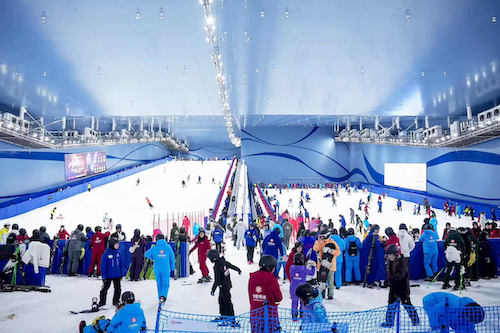
An ecosystem platform: building competitive strength through system capability
Bonski has continued to invest in product innovation and technology upgrades. Liu Wensheng outlined the company’s attention to intelligent energy management systems, including a proprietary energy-efficient snowmaking algorithm and a smart environmental control system capable of precise temperature and humidity regulation alongside energy optimisation. The digital operations platform is also being continuously refined.
On the product side, Bonski has integrated ski training, professional competitions, a membership platform and new consumer leisure formats into a broader “ice and snow plus” cultural tourism experience. Guangzhou Bonski, for instance, has built Asia’s largest indoor ski terrain park. Individual resorts are also progressively upgrading their snow play zones to offer a richer all-round experience.
Asked about the sources of Chinese ice and snow companies’ international competitiveness, Liu Wensheng pointed to full-industry-chain integration capability, the technology-driven advantages of Chinese manufacturing, and the scale and cost-effectiveness of solutions developed on the back of a vast domestic market.
The product Bonski most wants to take to the world is its indoor snow theme complex; a complete integrated solution. It is more than a physical space. It is an ecosystem platform combining professional skiing, snow entertainment and themed commercial retail. Its core strength lies in a modular, standardised design and construction system, combined with intelligent environmental controls and green operating standards. This enables rapid deployment across different climate zones globally, delivering a year-round snow experience. The model is particularly well suited to regions that want to develop an ice and snow industry but are constrained by natural conditions.
Addressing the priorities international clients hold most; quality, safety, creativity and long-term service, Liu Wensheng was clear. Bonski takes industry-leading standards as its baseline, embedding safety and quality control across the full project lifecycle and continuously delivering original snow environments and cultural tourism concepts. For long-term service, the company has established a full-process standardised management system, and assigns dedicated service teams to overseas projects, providing operational management, talent training and ongoing upgrade support.
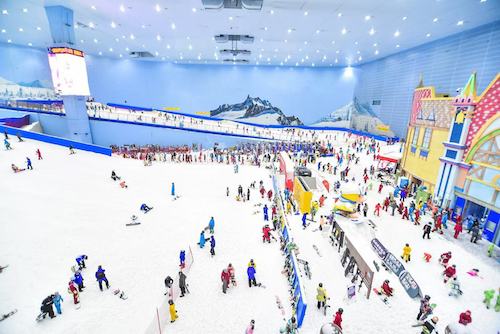
Going global
In terms of geography, Bonski is currently focused on South-east Asia and the Middle East. Both regions
have hot climates and limited natural ski resources, but are experiencing rapid economic growth and relatively strong demand for indoor snow experiences. Through the opportunities created by the Belt and Road Initiative, the company is exporting integrated solutions for ice and snow venue planning, construction and full-chain operations, adapting each project to local conditions.
Liu Wensheng spoke candidly about both the opportunities and challenges of overseas expansion. Growing interest in snow sports and climate change are driving demand for indoor ski resorts, while Chinese companies now offer highly cost-effective, fully integrated solutions backed by supportive policy. However, international awareness of Chinese snow brands remains limited, particularly in local operations and cross-cultural service delivery. In response, Bonski is establishing regional technical service centres and partnering with local operators to develop flagship projects overseas. Looking ahead, Liu said the company would focus on technology, innovation and global partnerships, while inviting international industry partners to visit Bonski’s resorts across China.
“We are willing to share our ‘snow experience’ with the world,” he said. “We look forward to working with global partners to bring the joy of year-round snow to more countries and regions.”
Image: Bonski